
Consolidating and promoting strength of great national unity bloc
The 11th National Congress of the Viet Nam Fatherland Front for the 2026-2031 tenure officially opens in Ha Noi on May 12.
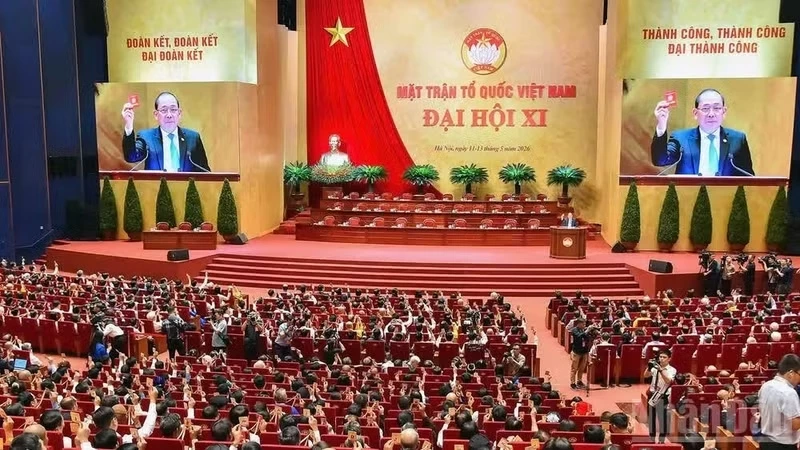 |
| An overview of the preparatory session of the 11th National Congress of the Viet Nam Fatherland Front. (Photo: Nhan Dan Newspaper) |
Taking place immediately after the resounding success of the 14th National Party Congress and the elections of deputies to the 16th National Assembly and People’s Councils at all levels for the 2026-2031 tenure, following more than one year of implementing the Resolution of the 10th National Congress of the Viet Nam Fatherland Front and nearly one year of operating under the new organisational model, the congress is an important political event embodying the will and aspirations of people from all walks of life. It opens a new tenure for the operation of the Front’s institutional apparatus with major stature, position, and responsibilities following the restructuring of socio-political organisations and mass associations.
Looking back on the glorious history of the nation, especially over the past 40 years of steadfastly implementing the renewal policy, we can proudly affirm that the Viet Nam Fatherland Front has always been a strong bridge between the Party, the state, and the people, playing the central role in fostering unity and acting as the political core in consolidating and promoting the immense strength of the great national unity bloc. Under the “common roof” of the Front, every social stratum and every force has affirmed its irreplaceable role.
Under the wise and absolute leadership of the Party, the front has operated with increasing effectiveness, depth, and long-term vision. The more arduous the revolutionary path becomes, the more flexible and creative the organisational methods of the front are, and the greater the strength of the great national unity bloc grows, clearly demonstrating continuity in line with the great goals set for the country.
Overcoming complex developments and fluctuations, the Viet Nam Fatherland Front has left remarkable marks, particularly in communications and mobilisation work to create consensus among the people regarding the restructuring of administrative units and the two-tier local governance model. It has also made decisive contributions to the great success of the elections of deputies to the National Assembly and People’s Councils at all levels, while enhancing the effectiveness of supervision and social criticism. The front has consistently demonstrated its exemplary and pioneering role in implementing the policy of streamlining the organisational apparatus, remaining close to grassroots communities, and creating conditions for the new governance structure to quickly stabilise and operate effectively and efficiently.
The prouder we are of these achievements, the more frankly we must recognise the shortcomings and challenges ahead. These include the difficult living conditions still faced by part of the population, especially in remote and ethnic minority areas; the widening rich-poor gap; increasingly severe, complex, and unpredictable non-traditional challenges; moral degradation among a section of officials and Party members, which has somewhat affected public trust; and especially hostile forces that have not abandoned their schemes to sabotage and divide the great national unity bloc.
Entering a new era, with the Party and state restructuring the organisational apparatus and establishing the Party Committee of the Viet Nam Fatherland Front and Central mass organisations to directly lead socio-political organisations and mass associations, the Viet Nam Fatherland Front has been elevated to a new stature and position, but it also faces urgent requirements. Mobilising the masses, therefore, cannot only stop at surface-level movements but must focus on resolving pressing and practical issues affecting people at the grassroots level, taking the people’s satisfaction and well-being as the highest measure of effectiveness.
Taking advantage of digital transformation, the front must always closely connect with the people, promptly and thoroughly grasping the aspirations and concerns of all social groups, both locally and in cyberspace. Supervision and social criticism must be further enhanced, linked to the role of representing and protecting the legitimate rights and interests of the people, especially through leading supervisors, cadres and Party members in moral conduct, lifestyle, and the performance of public duties. Social criticism activities must be carried out early and proactively. Major campaigns must align closely with national goals on digital transformation, green transformation, circular economy development, and sustainable poverty reduction.
These major responsibilities can only be fulfilled when the front’s organisational apparatus and contingent of officials are built and consolidated in a streamlined, strong, and efficient manner. The merger and restructuring of the system are challenges, but also opportunities for the front system to stabilise its organisation, establish more transparent and effective coordinated mechanism, and cultivate a contingent of officials with stronger political steadfastness and greater dedication, in the spirit of “respecting the people, staying close to the people, understanding the people, learning from the people, and being responsible to the people.”
Our country is standing before historic opportunities, challenges and prospects. In this context, the documents of the 14th National Party Congress emphasised the strength of the great national unity bloc and highlighted the need to continue renewing the content and methods of operation while further deepening the core political role of the front and socio-political organisations in promoting the people’s right to mastery.
Under the Party’s wise leadership and with a streamlined and effective organisational mechanism, we firmly believe that this strength will steer the revolutionary ship of the nation toward new horizons of development, well-being, prosperity, and happiness.
NDO


READER COMMENTS